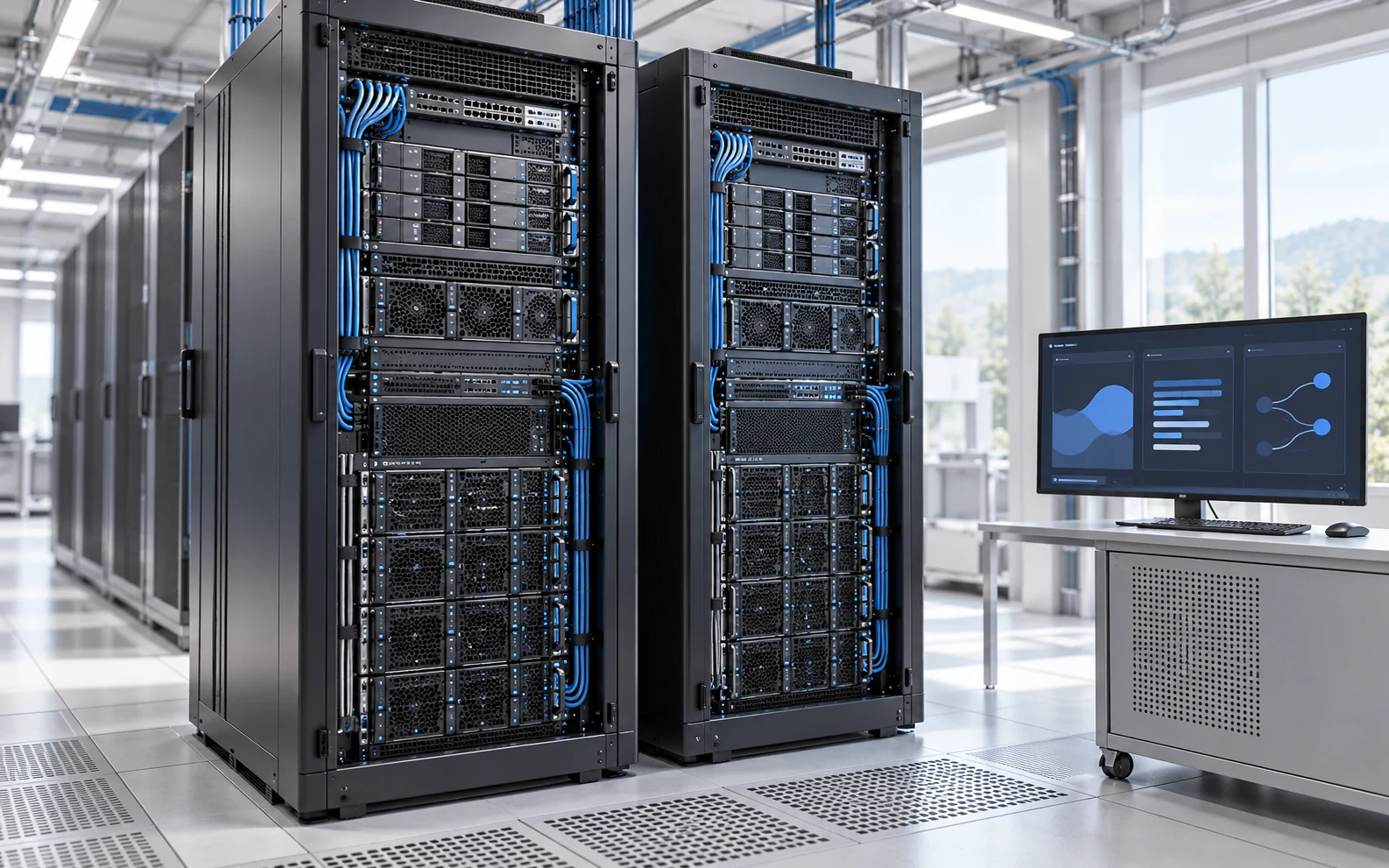
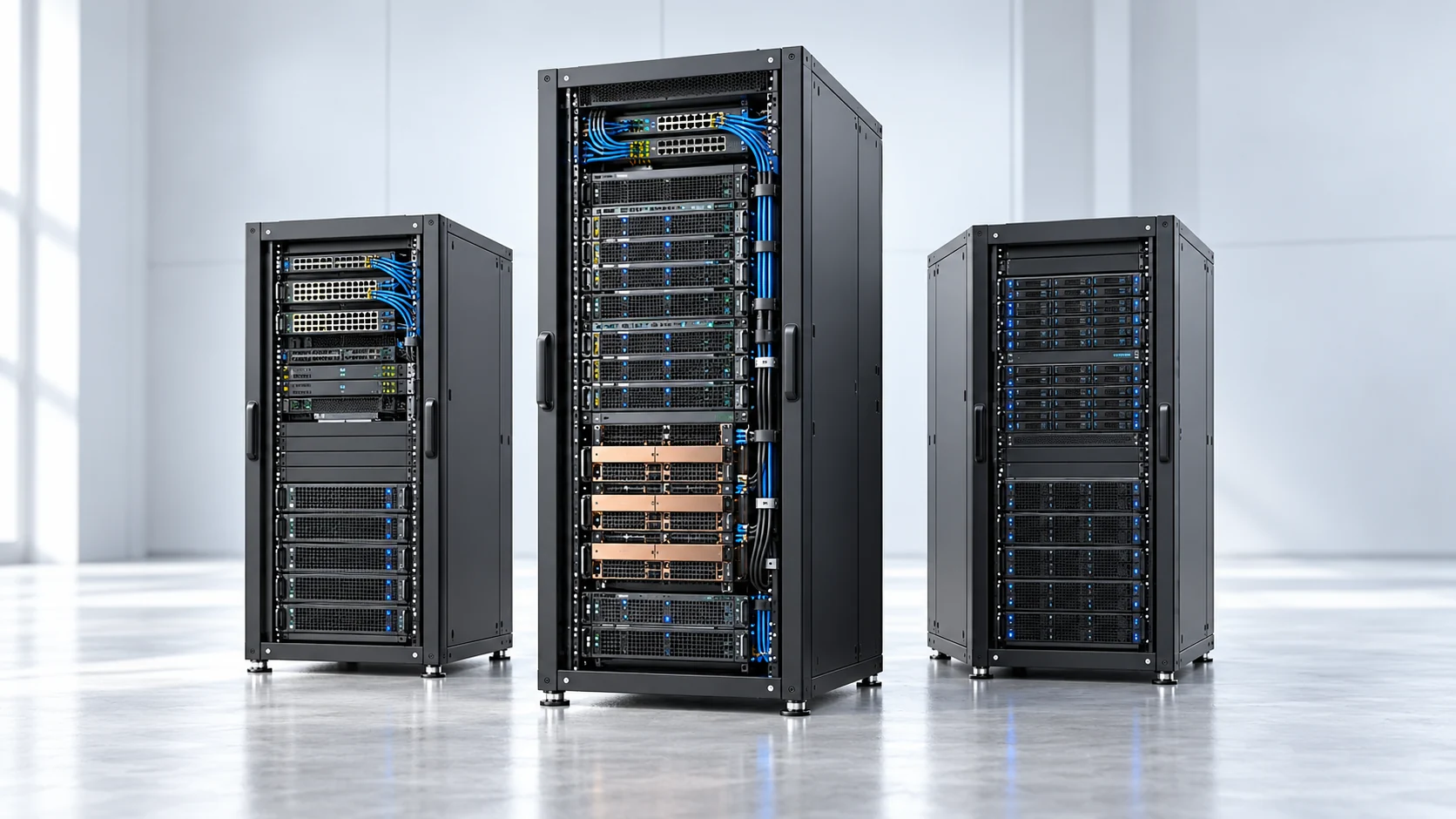
Rack-scale AI infrastructure for training and inference.
Cloud 9 sources and supplies NVIDIA- and AMD-based AI infrastructure, from integrated GPU racks to multi-rack compute deployments. Platform selection brings compute, networking, storage, power and cooling into one hardware specification, shaped by the workload and deployment environment.
From individual servers to a coordinated compute platform.
At infrastructure scale, the specification extends beyond the compute node. Accelerator communication, access to shared data, power distribution and cooling must support the way the workload is divided and operated across the deployment.
An integrated rack-scale platform and a cluster of independent servers solve that problem differently. Cloud 9 brings those architectural choices into the hardware-supply discussion, with compute and supporting equipment considered as one deployment requirement.
Integrated rack-scale platforms
Compute assemblies, accelerator interconnect and rack services form a coordinated reference architecture.
Networked server-node deployments
Complete GPU servers are connected through a specified network, with storage and operating infrastructure supporting the cluster.
A populated rack and an integrated rack-scale compute domain are not interchangeable.
Explore AI infrastructure architectures.
Select a platform to examine its rack architecture, compute building blocks and deployment considerations. The technical information describes manufacturer platforms; the final hardware configuration and supply scope are established for each requirement.
NVIDIA GB300 NVL72. Integrated rack-scale platform. The whole rack remains visible. Six callouts explain compute, interconnect, network/data access, power, cooling and service. Representative GB300 NVL72 architecture, not a stocked Cloud 9 configuration.
Integrated rack-scale platform
NVIDIA GB300 NVL72
A coordinated Grace Blackwell Ultra rack for substantial training and model-serving requirements. Evaluate its compute domain together with the infrastructure that feeds and operates it.
Compute assemblies
72 Blackwell Ultra GPUs in the reference rack. 36 NVIDIA Grace CPUs. Define software and working-set requirements before selecting the deployment size.
Technical fields and manufacturer sources
Compute building block
72 Blackwell Ultra GPUs in the reference rack Source: S01, S14, S15
Host architecture
36 NVIDIA Grace CPUs Source: S01, S14, S15
GPU memory basis
20 TB GPU memory across the reference rack, manufacturer-rounded and distributed across devices Source: S01, S14, S15
Accelerator communication
Fifth-generation NVLink within the 72-GPU rack domain Source: S01, S14, S15
Scale-out and data
Specified InfiniBand or Spectrum-X Ethernet scale-out Source: S01, S14, S15
Every platform remains readable when interactive controls are unavailable.
NVIDIA GB300 NVL72
A coordinated Grace Blackwell Ultra rack for substantial training and model-serving requirements. Evaluate its compute domain together with the infrastructure that feeds and operates it.
Compute building block
72 Blackwell Ultra GPUs in the reference rack Source: S01, S14, S15
Host architecture
36 NVIDIA Grace CPUs Source: S01, S14, S15
GPU memory basis
20 TB GPU memory across the reference rack, manufacturer-rounded and distributed across devices Source: S01, S14, S15
Accelerator communication
Fifth-generation NVLink within the 72-GPU rack domain Source: S01, S14, S15
Scale-out and data
Specified InfiniBand or Spectrum-X Ethernet scale-out Source: S01, S14, S15
Reference architecture, subject to selected implementation Source: S01, S14, S15
Large-model serving, reasoning and distributed training where the workload can use this communication domain.
Compute assemblies: 72 Blackwell Ultra GPUs in the reference rack. 36 NVIDIA Grace CPUs. Define software and working-set requirements before selecting the deployment size.
Accelerator interconnect: Fifth-generation NVLink within the 72-GPU rack domain. This is a defined domain; adding racks does not automatically extend it.
Network and data access: Specified InfiniBand or Spectrum-X Ethernet scale-out. Shared storage and management requirements must be considered separately.
Power delivery: Rack distribution and facility feeds are specified together. Power-system ratings must match the selected GB300 implementation and the complete installed equipment.
Cooling path: Liquid-cooled rack architecture. Confirm the facility interface, heat removal and service arrangements.
Service and operation: Plan access to compute and interconnect assemblies, service clearance and facility connections. Maintenance procedures follow the supplied implementation.
A Grace Blackwell rack-scale architecture with a defined accelerator domain. Consider the complete rack rather than treating it as a stack of B200 server nodes.
Compute building block
72 Blackwell GPUs in the reference rack Source: S02, S14, S15
Host architecture
36 NVIDIA Grace CPUs Source: S02, S14, S15
GPU memory basis
13.4 TB HBM3E across the reference rack, manufacturer-rounded Source: S02, S14, S15
Accelerator communication
Fifth-generation NVLink within the 72-GPU rack domain Source: S02, S14, S15
Scale-out and data
Specified Ethernet or InfiniBand network beyond the rack domain Source: S02, S14, S15
Reference architecture, subject to selected implementation Source: S02, S14, S15
Large-scale inference and training suited to an integrated Grace Blackwell rack.
Compute assemblies: 72 Blackwell GPUs in the reference rack. 36 NVIDIA Grace CPUs. Define software and working-set requirements before selecting the deployment size.
Accelerator interconnect: Fifth-generation NVLink within the 72-GPU rack domain. This is a defined domain; adding racks does not automatically extend it.
Network and data access: Specified Ethernet or InfiniBand network beyond the rack domain. Shared storage and management requirements must be considered separately.
Power delivery: Confirm rack distribution and facility supply against the implementation. GPU power alone does not specify the rack electrical requirement.
Cooling path: Liquid-cooled rack architecture. Confirm the facility interface, heat removal and service arrangements.
Service and operation: Tray and switch access, coolant connections and maintenance clearance are part of the rack layout. Service procedures follow the selected GB200 implementation.
A rack-scale platform built around Vera hosts and Rubin accelerators, with its own compute, interconnect and I/O architecture for substantial distributed AI requirements.
Compute building block
72 Rubin GPUs in the reference rack Source: S03, S14, S15
Host architecture
36 NVIDIA Vera CPUs Source: S03, S14, S15
GPU memory basis
Up to 20.7 TB HBM4 across the reference rack; preliminary manufacturer specification Source: S03, S14, S15
Accelerator communication
Sixth-generation NVLink within the rack domain Source: S03, S14, S15
Reference architecture, subject to selected implementation Source: S03, S14, S15
Large-model reasoning, training and agentic inference assessed against supported software and deployment requirements.
Compute assemblies: 72 Rubin GPUs in the reference rack. 36 NVIDIA Vera CPUs. Define software and working-set requirements before selecting the deployment size.
Accelerator interconnect: Sixth-generation NVLink within the rack domain. This is a defined domain; adding racks does not automatically extend it.
Network and data access: ConnectX-9 scale-out networking and BlueField-4 infrastructure roles. Shared storage and management requirements must be considered separately.
Power delivery: Electrical provision follows the selected Vera Rubin rack and its supporting equipment. Power distribution, protection and facility interfaces are established against the current system specification.
Cooling path: Liquid-cooled rack architecture; exact interfaces require implementation verification. Confirm the facility interface, heat removal and service arrangements.
Service and operation: Access to compute trays, interconnect assemblies and service connections follows the selected rack implementation. Installation planning must use its current dimensions and maintenance requirements.
Complete Blackwell Ultra server nodes coordinated through a deployment-level network. The intra-node accelerator domain is separate from communication between nodes.
Air or liquid cooling according to the selected complete server Source: S04, S14, S15
Rack population
Specified from the selected complete server and facility envelope Source: S04, S14, S15
Training, post-training and inference deployments using multiple tightly connected GPU nodes.
Compute assemblies: Eight Blackwell Ultra SXM GPUs per HGX B300 platform. Host CPU and memory of the selected complete server. Define software and working-set requirements before selecting the deployment size.
Accelerator interconnect: Fifth-generation NVLink and NVLink Switch inside each HGX node. This is a defined domain; adding racks does not automatically extend it.
Network and data access: Specified compute network connecting complete nodes. Shared storage and management requirements must be considered separately.
Power delivery: Use the chosen server power supplies and rack distribution. Population follows total power, thermal and physical constraints.
Cooling path: Air or liquid cooling according to the selected complete server. Confirm the facility interface, heat removal and service arrangements.
Service and operation: Preserve complete-node service access, network connections and coolant interfaces where present. Node replacement does not imply live-job continuity.
Blackwell server nodes connected as a deployment. Rack composition follows complete systems and their supporting services rather than a Grace Blackwell tray arrangement.
Host CPU and memory of the selected complete server Source: S04, S14, S15
GPU memory basis
1.4 TB per HGX B200 platform, manufacturer-rounded; not per rack Source: S04, S14, S15
Accelerator communication
Fifth-generation NVLink and NVLink Switch inside each HGX node Source: S04, S14, S15
Scale-out and data
Specified compute network between nodes, with data access and management requirements Source: S04, S14, S15
Cooling
Air or liquid cooling according to the selected complete server Source: S04, S14, S15
Rack population
Specified from the selected complete server and facility envelope Source: S04, S14, S15
Distributed AI jobs and model-serving capacity built from repeatable Blackwell compute nodes.
Compute assemblies: Eight Blackwell SXM GPUs per HGX B200 platform. Host CPU and memory of the selected complete server. Define software and working-set requirements before selecting the deployment size.
Accelerator interconnect: Fifth-generation NVLink and NVLink Switch inside each HGX node. This is a defined domain; adding racks does not automatically extend it.
Network and data access: Specified compute network between nodes, with data access and management requirements. Shared storage and management requirements must be considered separately.
Power delivery: Size node power feeds and rack distribution from the actual system. Include switches and storage in the electrical scope.
Cooling path: Air or liquid cooling according to the selected complete server. Confirm the facility interface, heat removal and service arrangements.
Service and operation: Allow access to nodes, cable routes and the selected heat-removal method. Rack density is configuration-specific.
Hopper-based server nodes connected for larger deployments. The SXM configuration supports a distinct node architecture, with software, data and communication requirements considered across the deployment.
Compute building block
Illustrated building block: eight-GPU HGX H200 SXM server Source: S05, S14, S15
Host architecture
Host architecture of the selected complete server Source: S05, S14, S15
GPU memory basis
141 GB HBM3E per GPU; no universal rack-memory total Source: S05, S14, S15
Specified scale-out network between servers Source: S05, S14, S15
Cooling
Cooling follows the selected HGX H200 server implementation Source: S05, S14, S15
Rack population
Specified from the selected complete server and facility envelope Source: S05, S14, S15
Memory-intensive inference, training and scientific applications with verified system and software support.
Compute assemblies: Illustrated building block: eight-GPU HGX H200 SXM server. Host architecture of the selected complete server. Define software and working-set requirements before selecting the deployment size.
Accelerator interconnect: Node-local HGX NVLink domain. This is a defined domain; adding racks does not automatically extend it.
Network and data access: Specified scale-out network between servers. Shared storage and management requirements must be considered separately.
Power delivery: Calculate rack electrical scope from complete servers and supporting equipment, not a single accelerator TDP.
Cooling path: Cooling follows the selected HGX H200 server implementation. Confirm the facility interface, heat removal and service arrangements.
Service and operation: Service access is planned around complete server nodes, cable routes and the rack installation. Equipment dimensions and maintenance procedures follow the selected system.
Networked PCIe GPU servers for AI and visual-computing deployments. Their accelerator arrangement remains distinct from HGX and integrated NVL72 systems.
Compute building block
RTX PRO 6000 Blackwell Server Edition cards in selected complete servers Source: S06, S07, S14, S15
Host architecture
Server host CPU and memory selected for the system Source: S06, S07, S14, S15
GPU memory basis
96 GB GDDR7 per GPU; card and rack counts are configuration-specific Source: S06, S07, S14, S15
Accelerator communication
PCIe server topology; no NVL72-style rack-wide accelerator domain Source: S06, S07, S14, S15
Scale-out and data
Server network interfaces and the specified deployment network Source: S06, S07, S14, S15
Cooling
Air or liquid cooling according to the chosen server Source: S06, S07, S14, S15
Rack population
Specified from the selected complete server and facility envelope Source: S06, S07, S14, S15
Model serving, industrial simulation and visual-computing workloads where RTX PRO Server capabilities matter.
Compute assemblies: RTX PRO 6000 Blackwell Server Edition cards in selected complete servers. Server host CPU and memory selected for the system. Define software and working-set requirements before selecting the deployment size.
Accelerator interconnect: PCIe server topology; no NVL72-style rack-wide accelerator domain. This is a defined domain; adding racks does not automatically extend it.
Network and data access: Server network interfaces and the specified deployment network. Shared storage and management requirements must be considered separately.
Power delivery: The electrical requirement includes the selected GPU population, server host and networking. Server power supplies and rack distribution must support that complete configuration.
Cooling path: Air or liquid cooling according to the chosen server. Confirm the facility interface, heat removal and service arrangements.
Service and operation: Maintain node and GPU service paths. Runtime, graphics and virtualisation requirements must match supported software and licences.
An AMD rack-scale reference architecture whose compute, interconnect and rack services are planned together. Preserve its distinct physical width and tray arrangement.
Compute building block
72 Instinct MI455X GPUs in the reference rack Source: S08, S14, S15
Host architecture
AMD EPYC Venice hosts Source: S08, S14, S15
GPU memory basis
Up to 31 TB HBM4 across the reference rack; manufacturer aggregate subject to change Source: S08, S14, S15
Accelerator communication
UALink / UALoE rack-scale accelerator communication Source: S08, S14, S15
Scale-out and data
AMD Pensando networking and the selected scale-out deployment Source: S08, S14, S15
Cooling
Liquid distribution to compute and switch trays through rack manifolds Source: S08, S14, S15
Rack population
Reference architecture, subject to selected implementation Source: S08, S14, S15
Large AI training and serving deployments using AMD rack-scale architecture and a supported ROCm environment.
Compute assemblies: 72 Instinct MI455X GPUs in the reference rack. AMD EPYC Venice hosts. Define software and working-set requirements before selecting the deployment size.
Accelerator interconnect: UALink / UALoE rack-scale accelerator communication. This is a defined domain; adding racks does not automatically extend it.
Network and data access: AMD Pensando networking and the selected scale-out deployment. Shared storage and management requirements must be considered separately.
Power delivery: The reference design uses central power shelves and vertical busbar distribution. Confirm ratings and facility interfaces for the implementation.
Cooling path: Liquid distribution to compute and switch trays through rack manifolds. Confirm the facility interface, heat removal and service arrangements.
Service and operation: The wider rack form, tray access and combined service connections affect installation and maintenance planning. Requirements follow the selected Helios implementation.
MI350X complete-server platforms organised as a networked deployment. The node-local communication domain remains distinct from Helios, with supporting infrastructure specified around the application and operating environment.
Host architecture of the selected complete server Source: S09, S10, S14, S15
GPU memory basis
2.3 TB HBM3E per eight-module platform, manufacturer-rounded; not per rack Source: S09, S10, S14, S15
Accelerator communication
AMD Infinity Fabric within each eight-module platform Source: S09, S10, S14, S15
Scale-out and data
Specified network between nodes; shared data and management defined separately Source: S09, S10, S14, S15
Cooling
Cooling follows the selected complete MI350X server implementation Source: S09, S10, S14, S15
Rack population
Specified from the selected complete server and facility envelope Source: S09, S10, S14, S15
Training, inference and compute deployments with application-specific MI350X validation.
Compute assemblies: Eight MI350X OAM modules per manufacturer platform. Host architecture of the selected complete server. Define software and working-set requirements before selecting the deployment size.
Accelerator interconnect: AMD Infinity Fabric within each eight-module platform. This is a defined domain; adding racks does not automatically extend it.
Network and data access: The selected network connects complete MI350X nodes. Compute traffic, shared storage access and management have distinct roles within the deployment.
Power delivery: Use the actual MI350X server envelope and rack distribution. MI355X power specifications are not interchangeable.
Cooling path: Cooling follows the selected complete MI350X server implementation. Confirm the facility interface, heat removal and service arrangements.
Service and operation: Service access, supported airflow and cable routes must remain practical in the populated rack. Operational requirements follow the selected complete-server implementation.
MI355X compute nodes deployed with the appropriate network and facility support. The physical arrangement follows the selected complete-server cooling and service design.
Cooling follows the selected complete MI355X server implementation Source: S09, S11, S14, S15
Rack population
Specified from the selected complete server and facility envelope Source: S09, S11, S14, S15
High-density training and serving using supported MI355X systems and an appropriate operating environment.
Compute assemblies: Eight MI355X OAM modules per manufacturer platform. Host architecture of the selected complete server. Define software and working-set requirements before selecting the deployment size.
Accelerator interconnect: AMD Infinity Fabric within each eight-module platform. This is a defined domain; adding racks does not automatically extend it.
Network and data access: Specified compute network between complete nodes. Shared storage and management requirements must be considered separately.
Power delivery: Confirm server power and rack distribution together. A module rating does not establish the facility requirement.
Cooling path: Cooling follows the selected complete MI355X server implementation. Confirm the facility interface, heat removal and service arrangements.
Service and operation: Coolant connections, node access and service clearance form part of the installation requirement. Maintenance procedures and replacement conditions follow the selected complete-server implementation.
MI300X platforms arranged as networked complete servers. Software, data access and communication requirements shape the deployment alongside accelerator memory and the selected server configuration.
Cooling and rack population follow the selected MI300X server Source: S12, S13, S14, S15
Rack population
Specified from the selected complete server and facility envelope Source: S12, S13, S14, S15
Inference, training and scientific workloads with verified MI300X system and software support.
Compute assemblies: Eight MI300X OAM modules per manufacturer platform. Host architecture of the selected complete server. Define software and working-set requirements before selecting the deployment size.
Accelerator interconnect: AMD Infinity Fabric within each eight-module platform. This is a defined domain; adding racks does not automatically extend it.
Network and data access: Specified scale-out network connecting complete nodes. Shared storage and management requirements must be considered separately.
Power delivery: Confirm server electrical inputs and rack distribution. Shared storage and network switches remain within the complete hardware requirement.
Cooling path: Cooling and rack population follow the selected MI300X server. Confirm the facility interface, heat removal and service arrangements.
Service and operation: Each complete server needs accessible operating interfaces and an appropriate maintenance route. Installation and service requirements follow the selected MI300X system.
Infrastructure for sustained, distributed AI workloads.
The right scale is set by the work and the way it will be operated. Training a distributed model, serving many requests and sharing resources across teams create different infrastructure requirements.
Large-model training and post-training
Training and adaptation at this scale require a deployment that reflects how the job is divided. Model structure, numerical format, working memory and communication patterns influence the compute choice. Dataset access and checkpoint writes belong in the same discussion, because the job must keep moving between compute stages.
Define the model, method and distribution strategy before fixing the rack count.
AI developers and research teams
High-volume inference and reasoning
A serving deployment must accommodate the pattern of requests, not only load a model. Context length, simultaneous demand, output length and response requirements shape the architecture. Some applications benefit from a tightly connected compute domain; others need capacity spread across model replicas or services.
Specify service demand and the software approach alongside the model.
AI service operators and organisations running substantial inference services
Shared GPU infrastructure
When multiple teams or applications share hardware, the operating model becomes part of the specification. Resource allocation, scheduling, management access and maintenance expectations need clear ownership. Capacity should reflect that pattern of use without implying that software, isolation or managed operation is automatically included.
Define who uses the infrastructure and how resources are allocated.
Shared-compute operators and multi-team organisations
Scientific AI and HPC
Scientific applications can combine numerical simulation, analysis and AI. Their requirements are not captured by one low-precision performance figure. Establish application support, numerical behaviour, datasets and the way calculations exchange data before selecting a platform and its network.
Start with the application and its numerical requirements.
Research institutions and technical computing teams
Physical AI and simulation at scale
Robotics, synthetic-data generation and industrial simulation can involve many parallel environments. Some stages require graphics and rendering as well as AI compute. Identify those stages explicitly so the deployment combines suitable resources rather than assuming that every accelerator has the same visual-computing capabilities.
Separate simulation, rendering and AI processing requirements.
Robotics developers and industrial technology organisations
Private and sovereign AI infrastructure
Organisations establishing local control need a hardware scope that fits their governance and operating requirements. Location, access control, software provenance, data handling and support responsibilities should be defined together. Hardware contributes to the deployment; it does not by itself establish sovereignty, compliance or security.
Define governance and operating responsibility as project requirements.
Institutions and organisations with defined local-control requirements
Application and deployment considerations, not universal performance or compatibility guarantees.
Data movement, power and cooling at rack scale.
Compute hardware relies on the systems around it. Define the paths for data, electrical power and heat removal alongside the platform rather than treating them as additions after GPU selection.
Network and data roles.
Communication and storage
The selected compute domain needs a clear route to the rest of the deployment. Accelerator communication, traffic between nodes or racks, shared data access and management perform different jobs. Network selection should follow those roles and the software using them.
Storage is part of that architecture: datasets must be read, local staging may reduce repeated transfers, and checkpoints must be written. Specify capacity and access behaviour together rather than choosing by peak transfer rate alone.
Integrated-rack power distribution follows the selected platform; node-based racks follow their server arrangement.
Power distribution
An integrated rack-scale design can use power shelves and busbar distribution, while independent server nodes may use their own power supplies and rack distribution. The architecture determines the path. Electrical provision must cover the complete installed equipment and its operating requirements.
Confirm facility feeds, distribution, protection, access and the agreed supply boundary against the actual configuration. A GPU power rating is not a rack electrical specification.
Facility power interfacePower conversion / shelfRack distributionCompute trayBoard-level power
Manufacturer sources: S08
Liquid-cooling roles, coolant conditions and facility interfaces follow the selected configuration.
Cooling and heat removal
For a liquid-cooled platform, the discussion includes the facility interface, coolant distribution and connections to heat-producing assemblies. Cold plates and manifolds must belong to a complete heat-removal path. Air-cooled nodes have their own airflow and room-cooling requirements.
Review specified coolant conditions, facility capacity, service procedures and access for the chosen system. Do not transfer temperature or flow values between platform generations.
Facility heat-removal interfaceCoolant distribution unitRack supply and returnTray connectionsCold plates
Manufacturer sources: S01, S07, S08
The complete AI infrastructure specification.
A rack-scale requirement is defined by the complete deployment. Cloud 9 sources and supplies the compute platforms and supporting hardware against an agreed configuration, with quantities, interfaces and infrastructure dependencies considered together.
The selected platform is a starting point. Final scope includes the intended software environment, physical installation requirements and the responsibilities agreed for supply and operation.
Selected architecture
NVIDIA GB300 NVL72
Compute and host
72 Blackwell Ultra GPUs in the reference rack; 36 NVIDIA Grace CPUs.
Communication
Fifth-generation NVLink within the 72-GPU rack domain; Specified InfiniBand or Spectrum-X Ethernet scale-out.
Memory and storage
20 TB GPU memory across the reference rack, manufacturer-rounded and distributed across devices. Define data access and local staging separately.
Power and cooling
Rack distribution and facility feeds are specified together. Power-system ratings must match the selected GB300 implementation and the complete installed equipment. Liquid-cooled rack architecture.
Installation and access
Plan access to compute and interconnect assemblies, service clearance and facility connections. Maintenance procedures follow the supplied implementation.
Software and scope
Confirm supported applications, versions, licences, operational responsibilities and the agreed hardware-supply scope.