Data pipelines and model loading
CPU-side data workers, preprocessing and staging can require substantial DRAM even when GPUs execute the main compute kernels. Streaming, prefetching and sharded loading can change the working set.

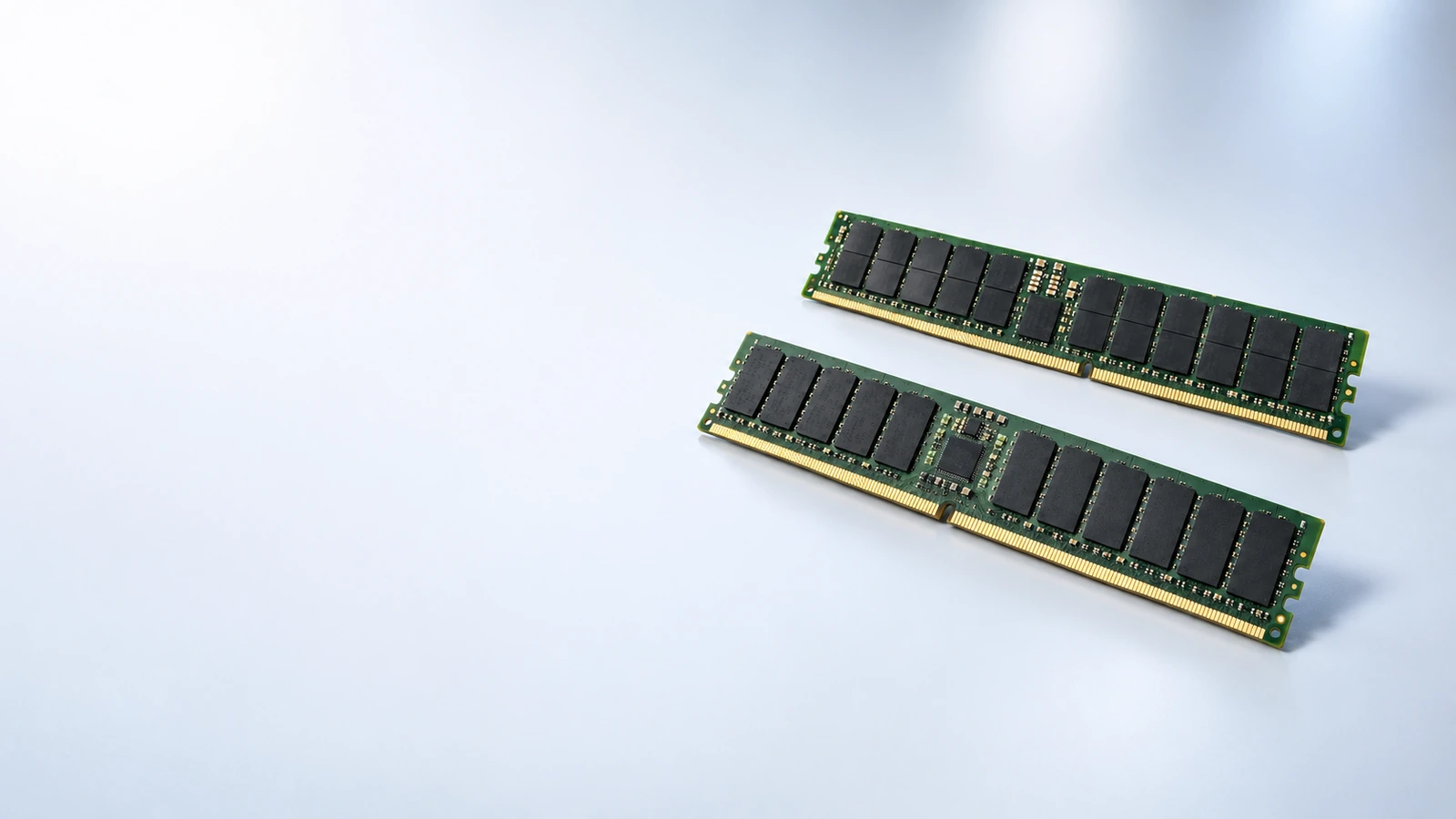
Cloud 9 sources and supplies registered and load-reduced system memory for compatible server and compute platforms. Explore DDR5 RDIMM and DDR4 LRDIMM architectures, including high-density modules for demanding host-memory configurations and carefully qualified upgrades.
AI servers rely on more than accelerator memory. Host DRAM supports data preparation and movement, CPU-side services, model and checkpoint loading, retrieval systems, virtual machines, and the concurrent processes surrounding training and inference. In a memory-constrained workflow, keeping more active data in host RAM can reduce movement to slower storage. The result depends on the workload and the rest of the system.
Large individual modules help raise memory capacity without occupying additional sockets. But the useful configuration begins with the processor's memory channels, the server board's qualified memory architecture and the way the workload uses host memory. Memory capacity and supported operating rate must be evaluated separately.
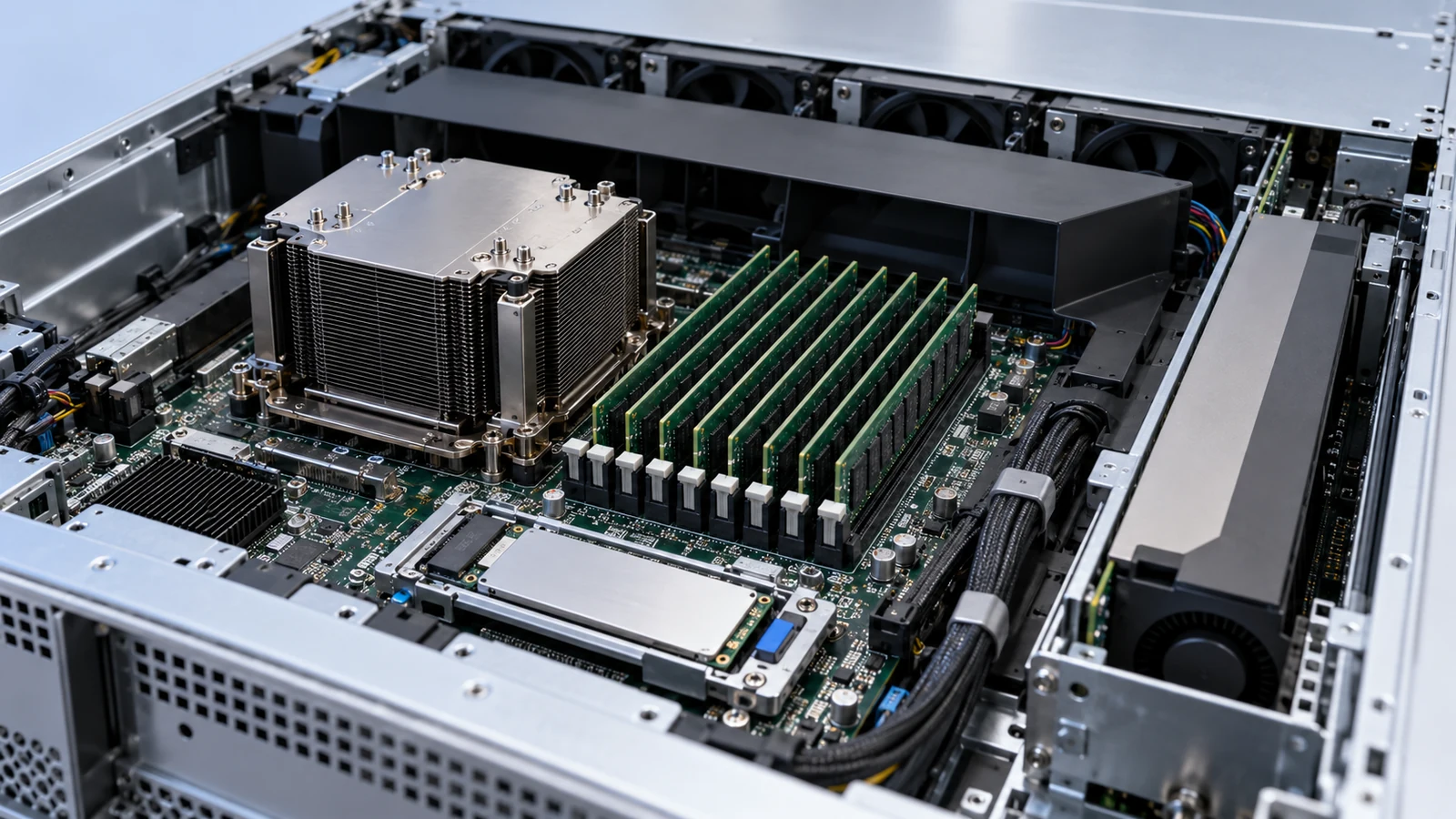
CPU-side data workers, preprocessing and staging can require substantial DRAM even when GPUs execute the main compute kernels. Streaming, prefetching and sharded loading can change the working set.
Inference serving, retrieval, caching, orchestration and virtualised services place different demands on host-memory capacity and bandwidth. More host DRAM does not increase an accelerator's physical HBM or VRAM.
A 256 GB DDR5 RDIMM or 256 GB DDR4 3DS LRDIMM is one physical module, not a kit. A 512 GB DDR5 RDIMM is a manufacturer development and sampling milestone, with production anticipated in H2 2027; it is not established Cloud 9 stock.
Module architecture affects how signals reach memory devices and which hosts can use them. Compare the DDR5 RDIMM registering clock driver with the separate data buffering of a DDR4 LRDIMM.
DDR5 ECC RDIMM · Module anatomy
DDR5 ECC RDIMM buffers the command/address/clock interface through a registering clock driver while the memory data path remains unbuffered at the module level. DDR5 DRAM brings on-die ECC; system-level ECC depends on the complete host configuration.
Per physical DIMMIndividual modules documented up to 256 GB; a single 512 GB DDR5 RDIMM has been demonstrated and entered sampling, with volume production expected in H2 2027.

The RCD handles control signalling. The conventional RDIMM data path does not pass through LRDIMM-style data buffers.
Data bus connects through the module separately from the RCD; sideband ECC is represented as a distinct host-supported path.
Memory signal roles.Select a component to explore its role.
Soldered DDR5 memory devices store host-side working data. Selected high-capacity 3DS modules stack DRAM dies within packages; the physical stack is internal to the package.
Platform fit: DDR5 RDIMM slot, approved rank and density, CPU microcode/BIOS, population and module QVL. A 512 GB development module is not automatically supported on existing servers.
Speed context: Current DDR5-4800 to DDR5-6400 JEDEC examples. An announced 512GB module targets up to DDR5-9200, not yet a confirmed general-purpose installed-system speed.
LRDIMM adds data buffers to registered clock/command distribution, reducing the electrical loading presented to the host memory interface. This teaching example is DDR4 because suitable, documented 256GB LRDIMM platform support exists there.
Per physical DIMMExamples of 64 GB, 128 GB and 256 GB capacity PER individual DDR4 3DS LRDIMM are supported by selected server boards. A 512GB single LRDIMM is not established by the current evidence.

The DDR4 register and separate data buffers perform different functions. This is not a DDR5 module layout.
Command and address signals pass through the register; data signals pass through the LRDIMM data buffers. System-level ECC operates with a compatible host memory controller.
DDR4 LRDIMM signal paths.Select a component to explore its role.
High-capacity DDR4 LRDIMMs can use stacked DRAM packages and multiple ranks to raise capacity per memory socket. Stack height cannot be inferred by eye alone.
Platform fit: DDR4 LRDIMM-qualified slots and population rules. Never mix with RDIMM, DDR5, or unsupported memory types; platform-specific speed/rank limits govern.
Speed context: DDR4-2666/2933/3200 MT/s are representative historical platform/module speeds; the example high-capacity 256GB platform supports DDR4-3200.
Reference status: 256GB is a capacity PER physical DDR4 LRDIMM on selected platforms; no validated 512GB LRDIMM SKU is claimed. RDIMM and LRDIMM must not be mixed.
RDIMMs and LRDIMMs are distinct architectures. Compatibility depends on memory generation, ranks, per-DIMM capacity, channel population, BIOS and the platform’s qualified memory list. Use the module architecture specified for the platform.
Each capacity is for one physical DIMM. The table compares separate RDIMM and LRDIMM architectures, with generation-specific transfer-rate and timing examples.
| Type | Module Capacity | Transfer Rate | ECC Support | Voltage | CAS Latency |
|---|---|---|---|---|---|
| DDR5 ECC RDIMM | 16–256 GB per module; 512 GB sampled* | 4800–6400 MT/s examples** | System-level sideband ECC + DDR5 on-die ECC | 1.1 V DRAM VDD/VDDQ nominal | CL40 / 46 / 52 at 4800 / 5600 / 6400 (examples) |
| DDR4 ECC LRDIMM | 64–256 GB per individual module*** | 2666–3200 MT/s examples | System-level ECC on compatible DDR4 hosts | 1.2 V DRAM nominal | CL19–22 reference bins, module-specific |
Documented supported configurations include 256 GB DDR5 RDIMMs and 256 GB DDR4 3DS LRDIMMs. Micron demonstrated a 512 GB DDR5 RDIMM in September 2026 and targets volume production in the second half of 2027. The 512 GB DDR5 RDIMM is a development reference, with transfer rates up to 9,200 MT/s targeted for the next-generation platform. The verified examples do not include a 512 GB LRDIMM.
Transfer rates and timings apply to the stated module and host configuration.
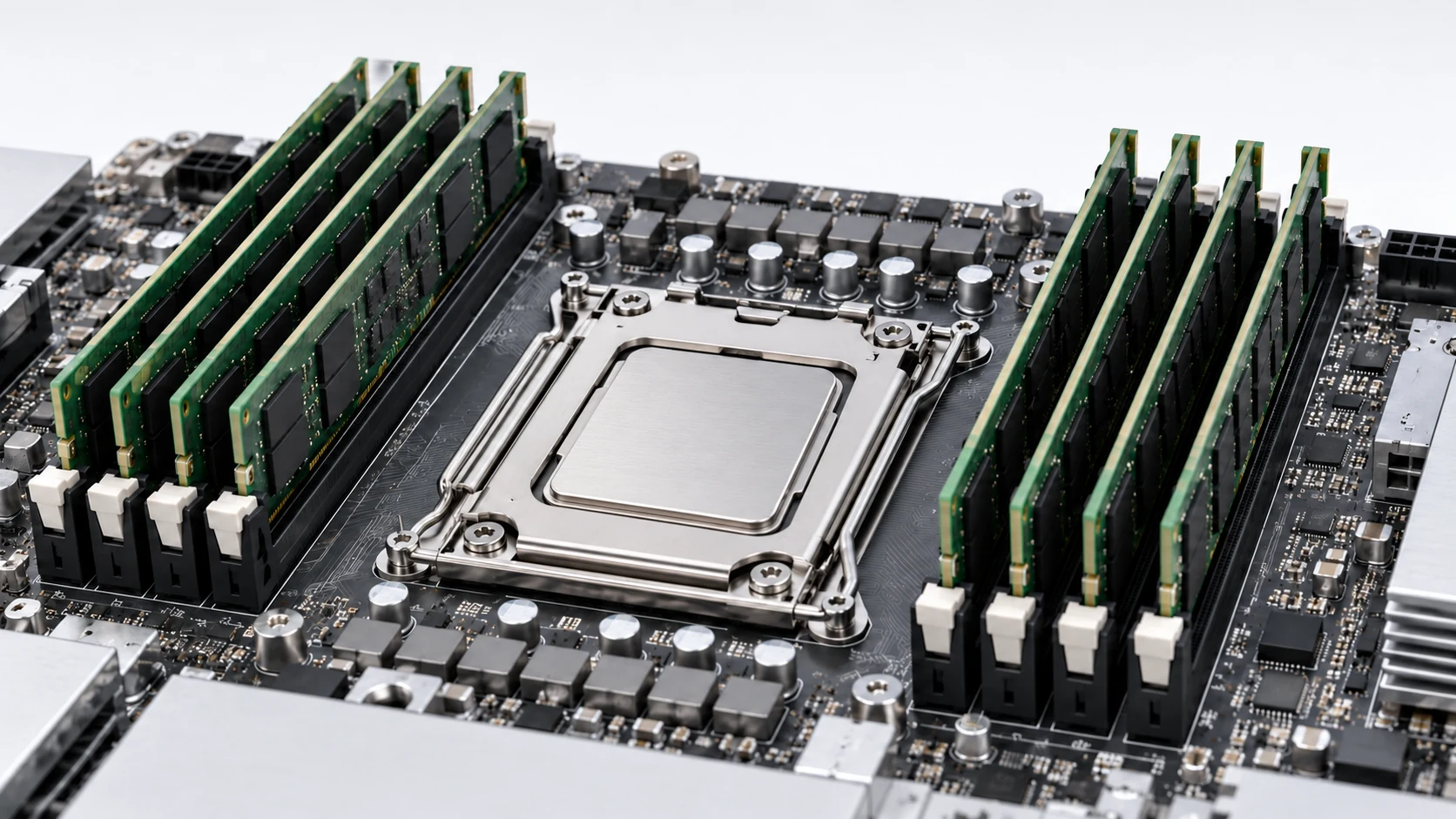
Match the processor, motherboard or server model, memory generation, BIOS, ranks and channel population to the qualified memory list. Use the RDIMM or LRDIMM population specified for that platform.
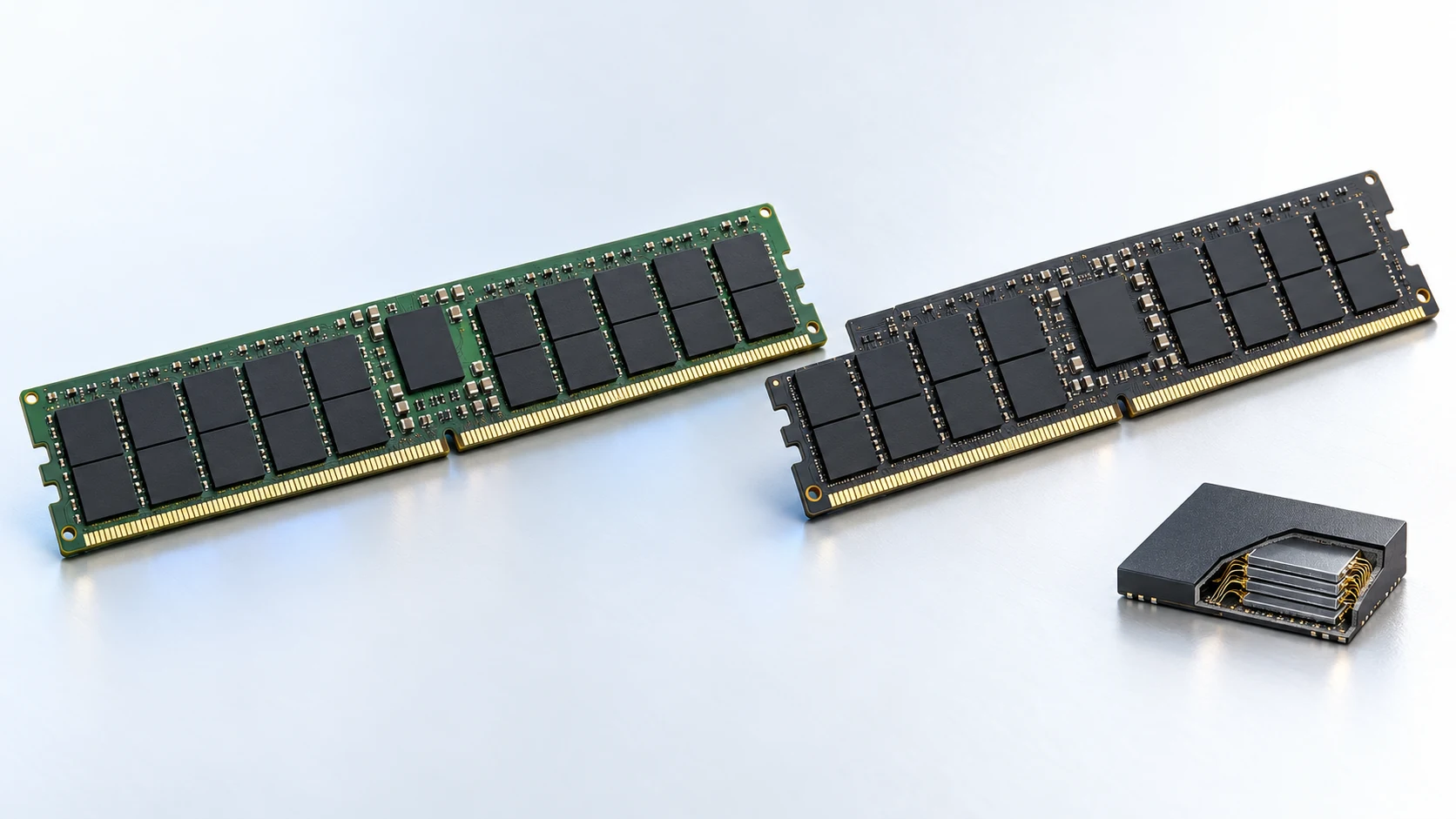
High-density DRAM and stacked-die packaging can increase capacity without adding DIMM sockets. For memory-heavy AI data pipelines, in-memory databases and shared services, the result can be more room for active data on the host.
Individual 256 GB DDR5 RDIMM and DDR4 3DS LRDIMM configurations are documented examples. The 512 GB DDR5 RDIMM development shows a next step, but remains distinct from available qualified products.
MT/s describes millions of data transfers per second. The arithmetic peak of a 64-bit DDR5-5600 data interface is 44.8 GB/s before overhead. This is a teaching calculation, not a system benchmark or a guarantee for a high-density module.
The controller's channel arrangement, rank organisation, module population and firmware limits determine what an installed server can sustain. More memory does not automatically produce proportionally more bandwidth.
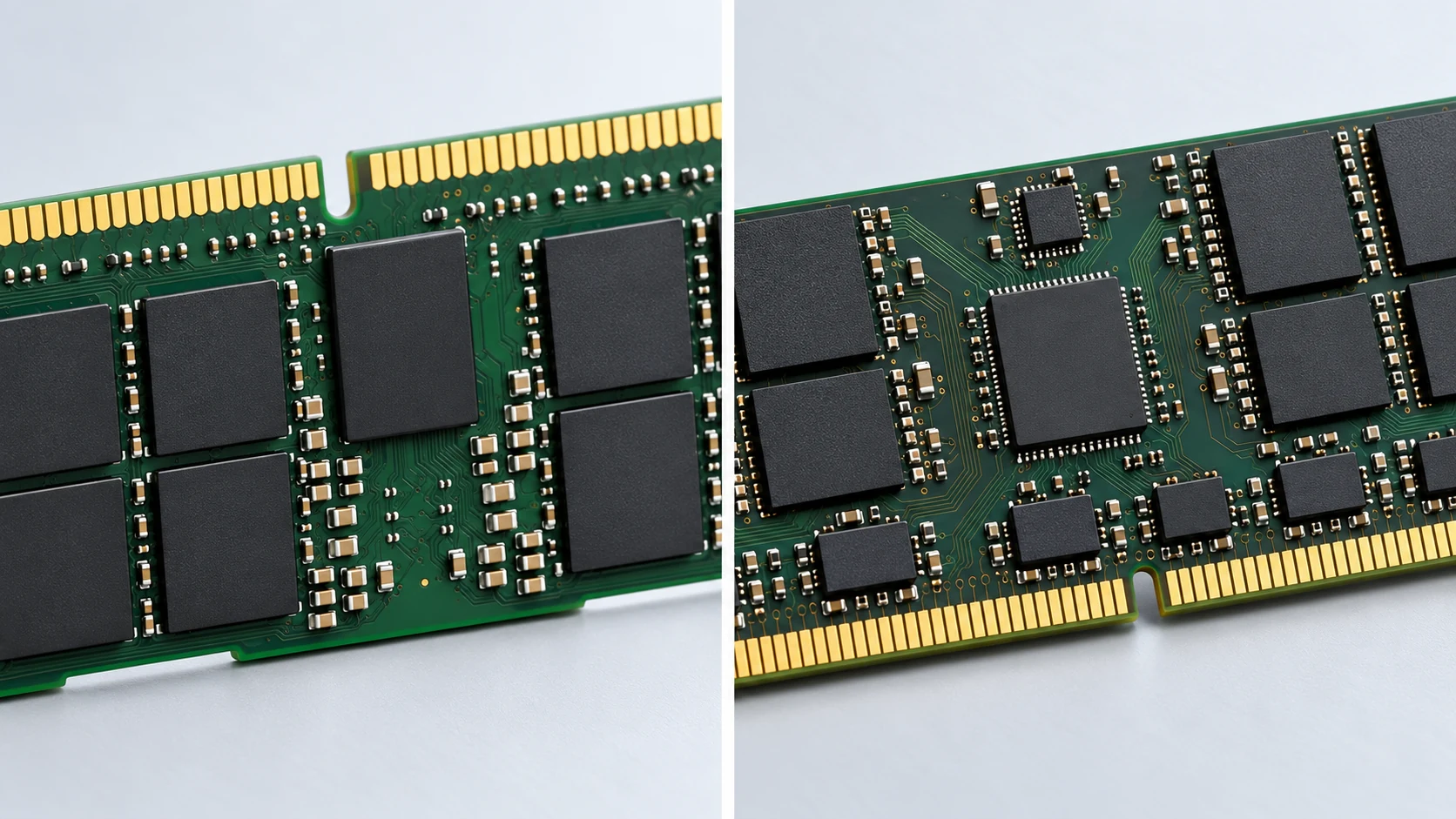
The DDR5 RDIMM registering clock driver and DDR4 LRDIMM register-plus-data-buffer design serve different electrical purposes. Registered signalling and load reduction help compatible platforms support demanding rank and module populations. Neither architecture guarantees lower latency or higher throughput in every installation.
Qualified system-level ECC, thermal sensing and monitoring support specified memory fault detection, correction and management. They do not guarantee error-free applications or a particular availability target.
Start with the host CPU and approved memory architecture. Then establish capacity per individual DIMM, supported channels and slots, rank and population rules, and the required operating rate. DDR5 RDIMM for compatible professional Threadripper platforms belongs in this commercial Server Memory category; DDR4 LRDIMM remains a separate choice for compatible server generations.