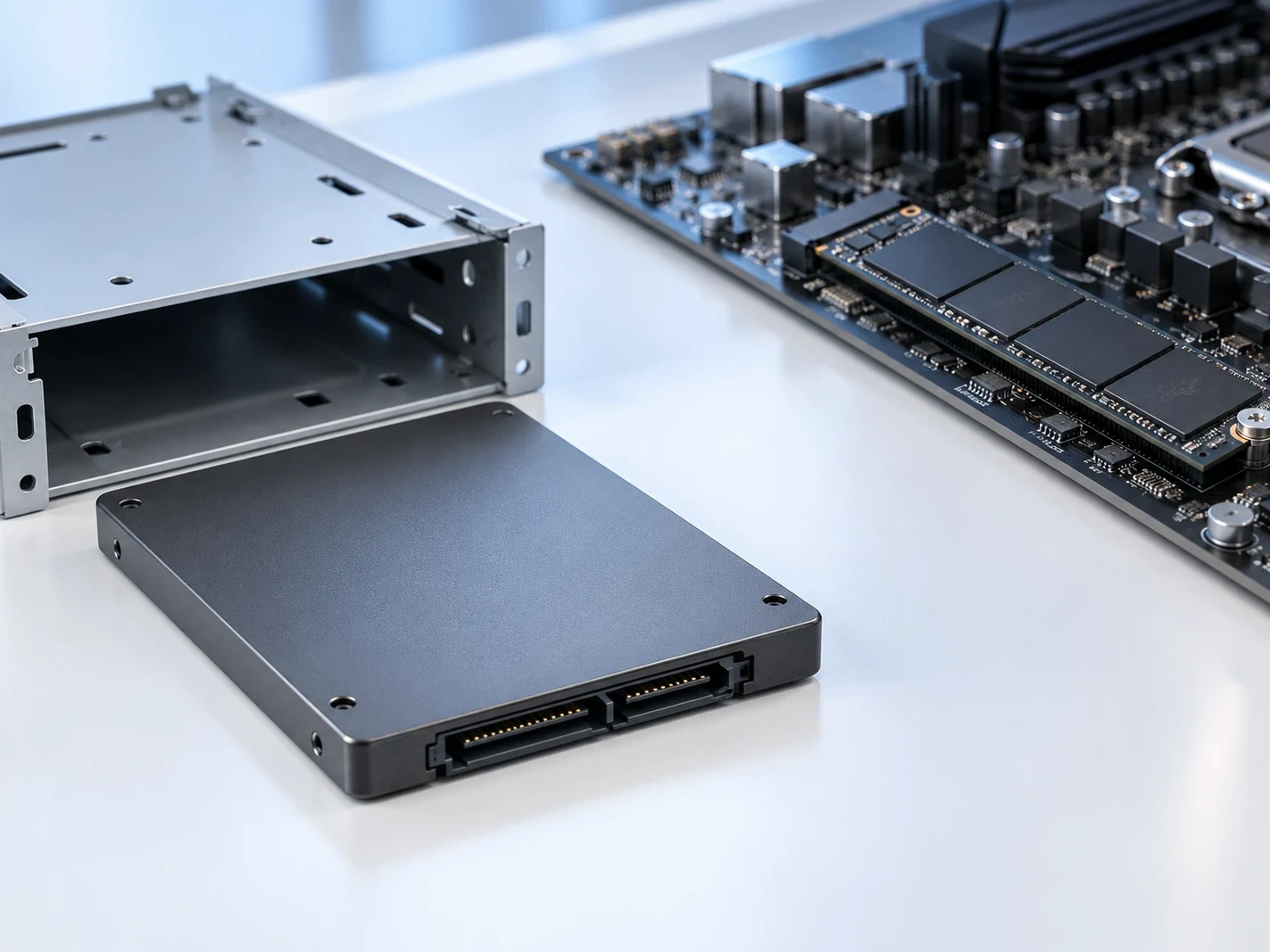
Complete 2.5-inch and B+M-key M.2 SATA SSDs on an engineering service bench beside storage bays.

SATA SSDs for compatible workstations and servers.

Solid-state capacity for operating systems, applications, model libraries and retained working data. Cloud 9 sources commercial and enterprise-class SATA drives in 2.5-inch and M.2 2280 formats.

Make more working data available to the system.

Not every AI workload needs its storage to operate at PCIe NVMe speeds. A system also needs places to hold operating environments, models, source data, media assets and the results of completed work. Where the application and host platform suit SATA, solid-state drives provide responsive access without relying on mechanical disks.

SATA SSDs have an established role in compatible workstations, existing servers and capacity-focused storage configurations. The practical choice depends on capacity, the way data is read and written, supported drive bays or slots, and the operating demands placed on the device.

Cloud 9 supplies SATA SSDs individually and as part of complete AI computing hardware. Faster interfaces remain preferable where sustained storage bandwidth is the overriding requirement; SATA remains relevant when the duty and physical system call for it.

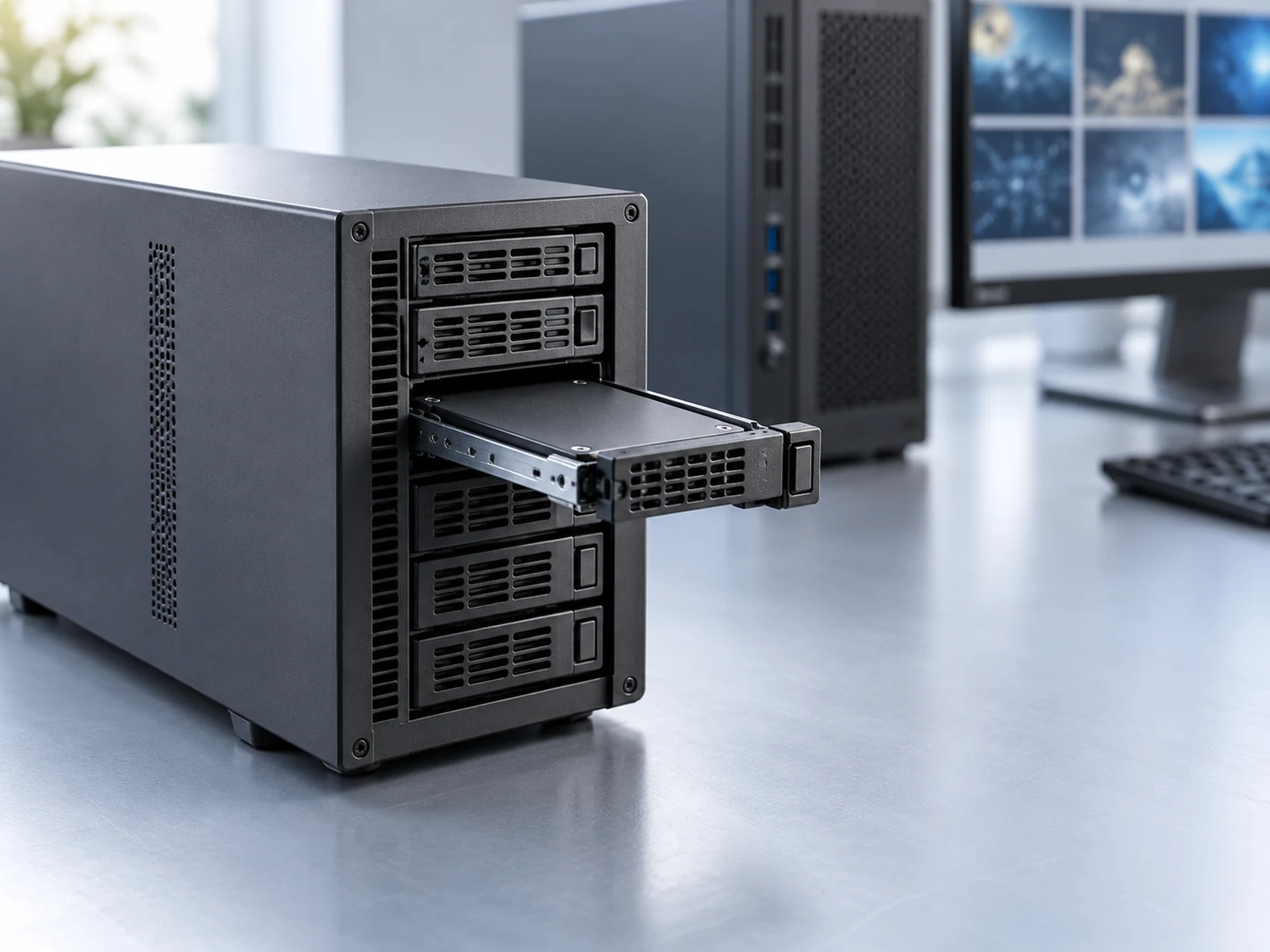
SATA SSD installed in a compatible workstation storage bay

Inside a SATA SSD.

Select a design to examine how NAND flash, the controller, cache and optional protection circuitry support the drive. These illustrations explain representative architectures and are not exact teardowns or purchasable configurations.

Choose a drive design

Selected design

2.5-inch | Enterprise

Physical format: 2.5-inch; reference-specific board and thermal shell

Qualified designs for defined server workloads, with endurance, power-loss behaviour, sustained response and management functions checked model by model.

Design considerations

    Representative 2.5-inch | Enterprise SATA SSD architecture with physical components shown for explanation

    Explore components

      Select a component to read its role.

      DRAM, encryption and hardware power-loss protection depend on the selected SSD model.

      All SATA designs

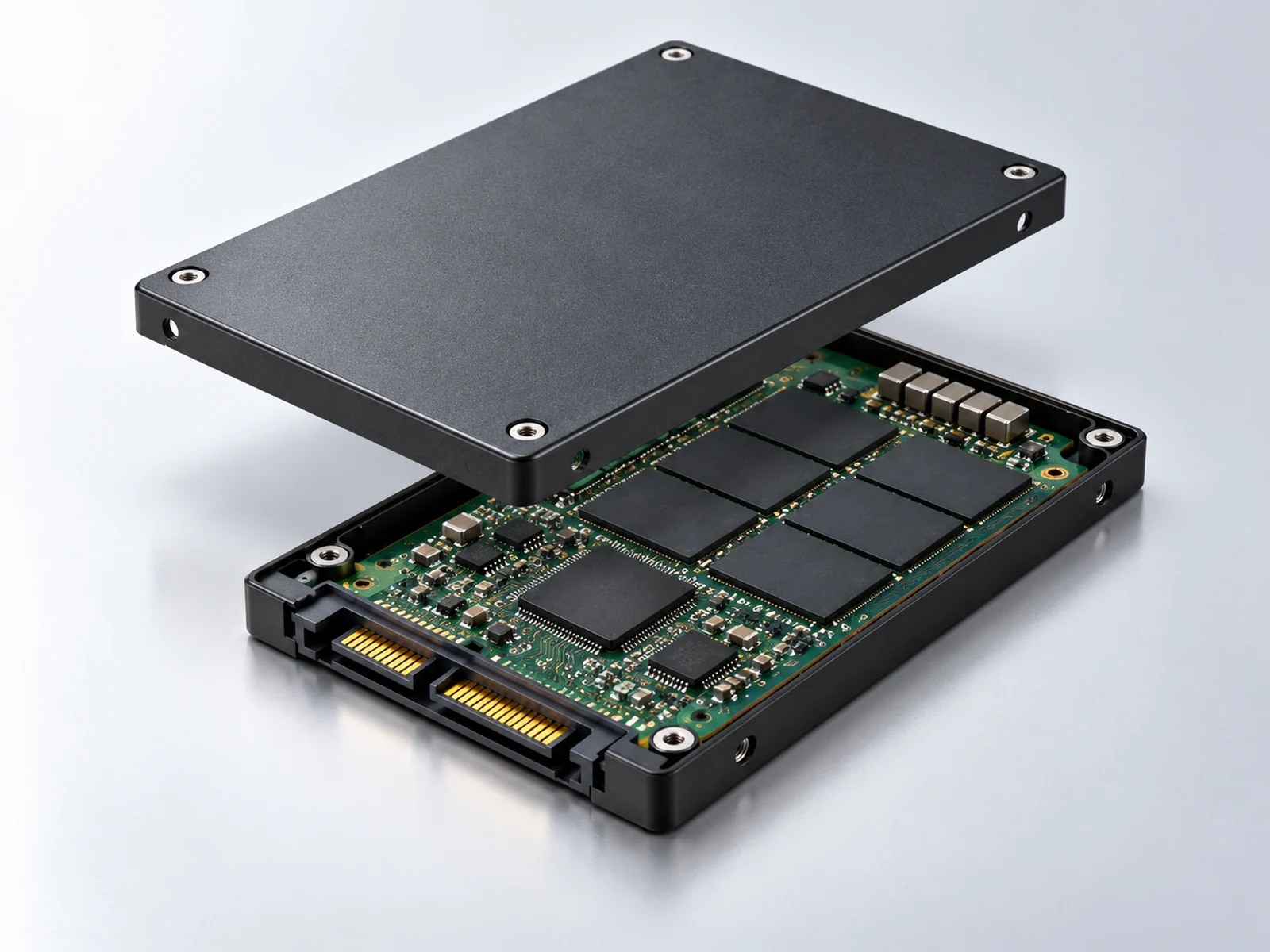
      2.5-inch | Commercial SATA SSD
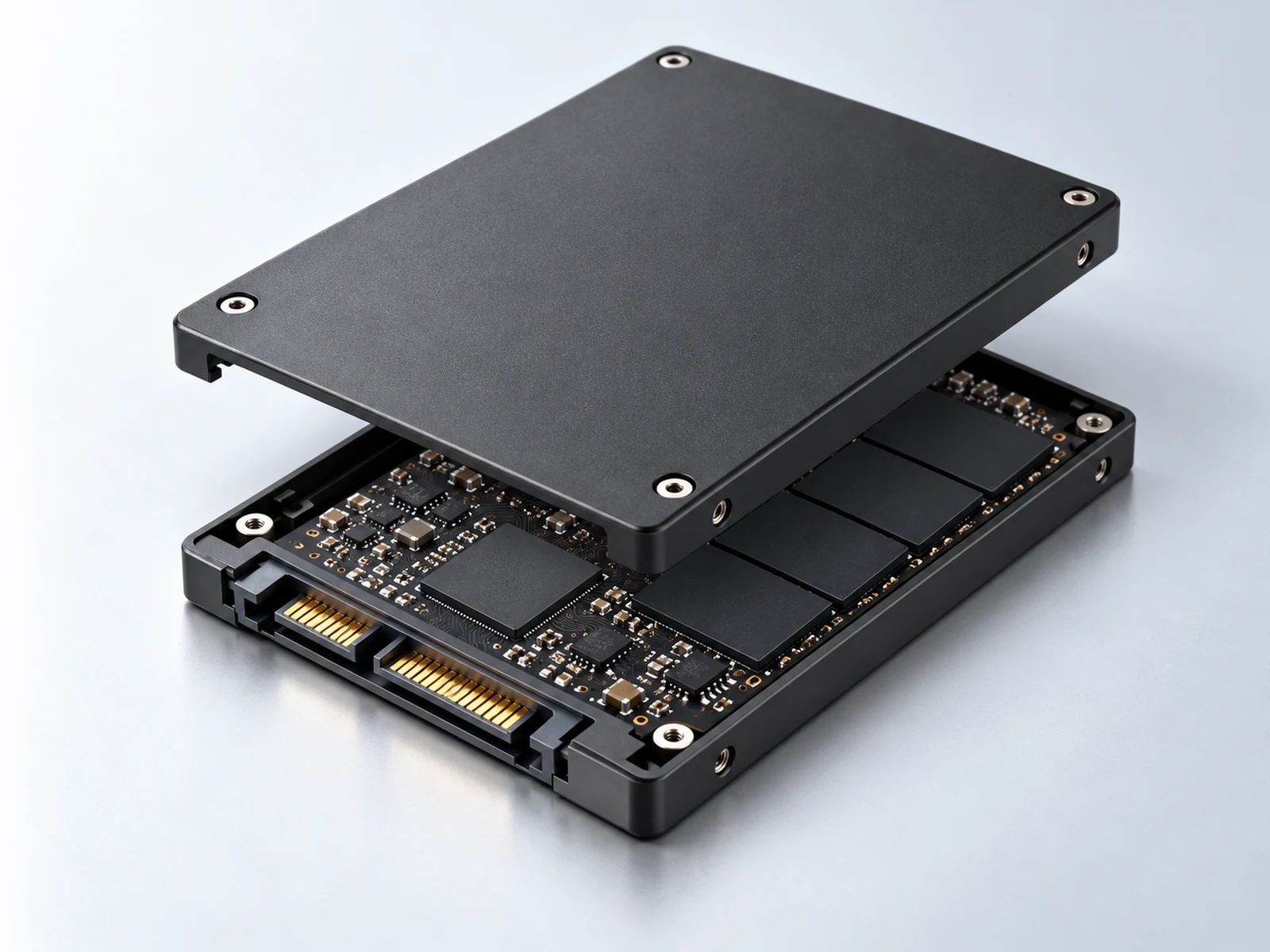
      Representative 2.5-inch | Commercial SATA SSD architecture with physical components shown for explanation

      Enclosed SATA storage for compatible system drives, model libraries and general working capacity. Drive controller, NAND and cache architecture depend on the selected product.

      Physical format: 2.5-inch; model thickness and connector fit subject to specification

      • Enclosure and thermal fit: The case protects the drive and must match the bay and cooling arrangement.
      • SATA data and power connection: A 2.5-inch SATA drive uses distinct data and power contacts. The host connection must match the drive.
      • SSD controller: The controller manages data placement, wear, recovery and communication with the host.
      • NAND flash: NAND flash stores the data. Technology and population vary by exact product.
      • Circuit board: The circuit board connects the controller, flash and host interface.
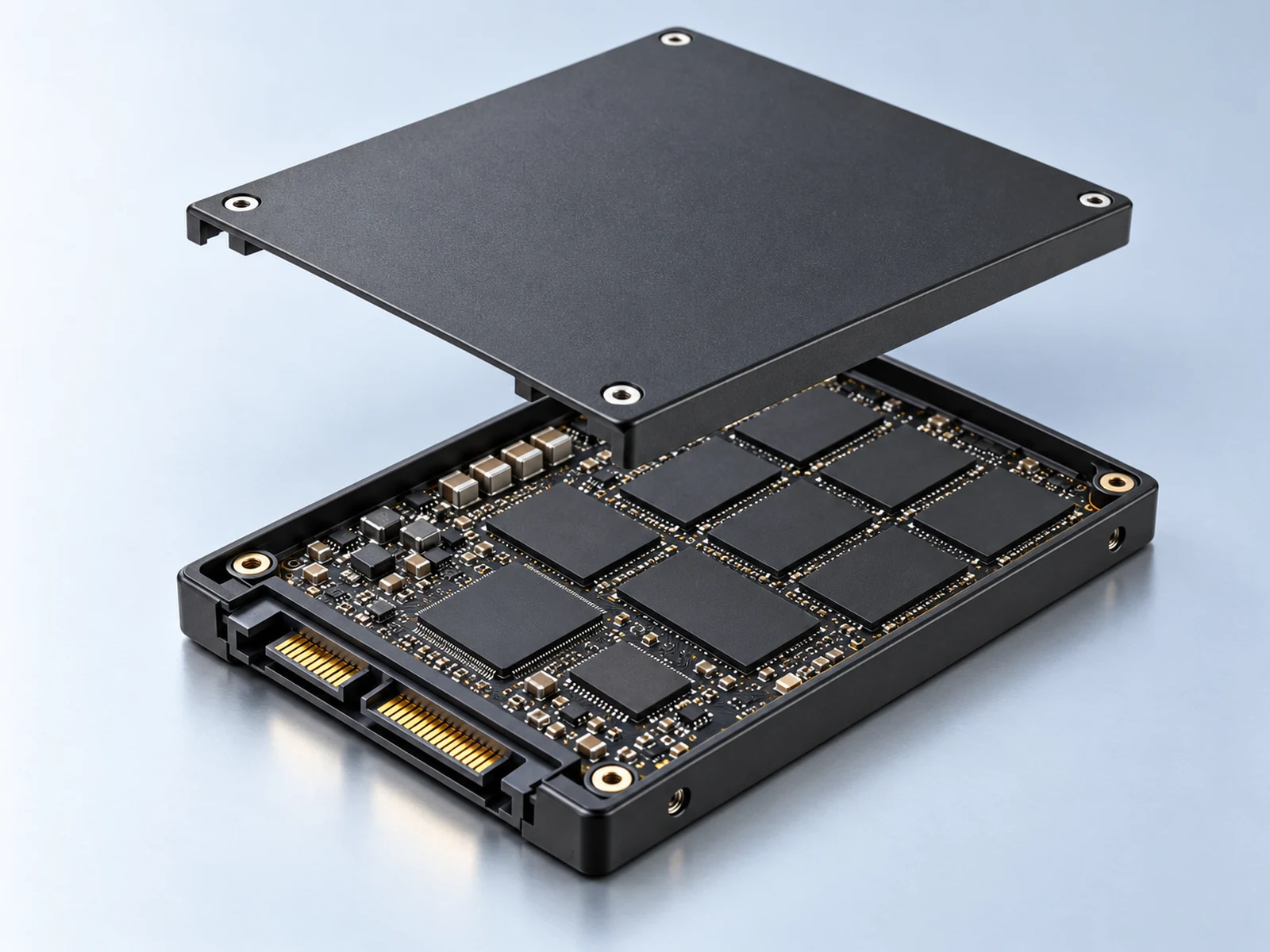
      2.5-inch | Enterprise SATA SSD

      Representative 2.5-inch | Enterprise SATA SSD architecture with physical components shown for explanation

      Qualified designs for defined server workloads, with endurance, power-loss behaviour, sustained response and management functions checked model by model.

      Physical format: 2.5-inch; reference-specific board and thermal shell

      • Enclosure and thermal fit: The case protects the drive and must match the bay and cooling arrangement.
      • SSD controller: The controller manages data placement, wear, recovery and communication with the host.
      • NAND flash: NAND flash stores the data. Technology and population vary by exact product.
      • DRAM, where fitted: Some models have dedicated DRAM for controller mapping and cache functions; others do not.
      • Hardware power-loss protection, where fitted: Selected verified enterprise models use hardware hold-up power to address interrupted writes.
      • SATA data and power connection: A 2.5-inch SATA drive uses distinct data and power contacts. The host connection must match the drive.

      2.5-inch | High capacity SATA SSD

      Representative 2.5-inch | High capacity SATA SSD architecture with physical components shown for explanation

      Enterprise SATA capacity up to 15.36 TB exists in a documented supplier series. The larger capacity does not change the SATA 6 Gb/s interface limit or promise a particular throughput.

      Physical format: 2.5-inch high-capacity ER4-family reference, not a Cloud9 SKU

      • Enclosure and thermal fit: The case protects the drive and must match the bay and cooling arrangement.
      • NAND flash: NAND flash stores the data. Technology and population vary by exact product.
      • SSD controller: The controller manages data placement, wear, recovery and communication with the host.
      • SATA data and power connection: A 2.5-inch SATA drive uses distinct data and power contacts. The host connection must match the drive.
      • Hardware power-loss protection, where fitted: Selected verified enterprise models use hardware hold-up power to address interrupted writes.

      M.2 2280 | SATA SATA SSD

      Representative M.2 2280 | SATA SATA SSD architecture with physical components shown for explanation

      A 22 × 80 mm board using the SATA protocol. An M.2 connector does not automatically support SATA; check the host documentation. Up to 4 TB is an intended range ceiling pending a confirmed Cloud 9 supplier model.

      Physical format: 22 × 80 mm

      • SSD controller: The controller manages data placement, wear, recovery and communication with the host.
      • NAND flash: NAND flash stores the data. Technology and population vary by exact product.
      • Circuit board: The circuit board connects the controller, flash and host interface.
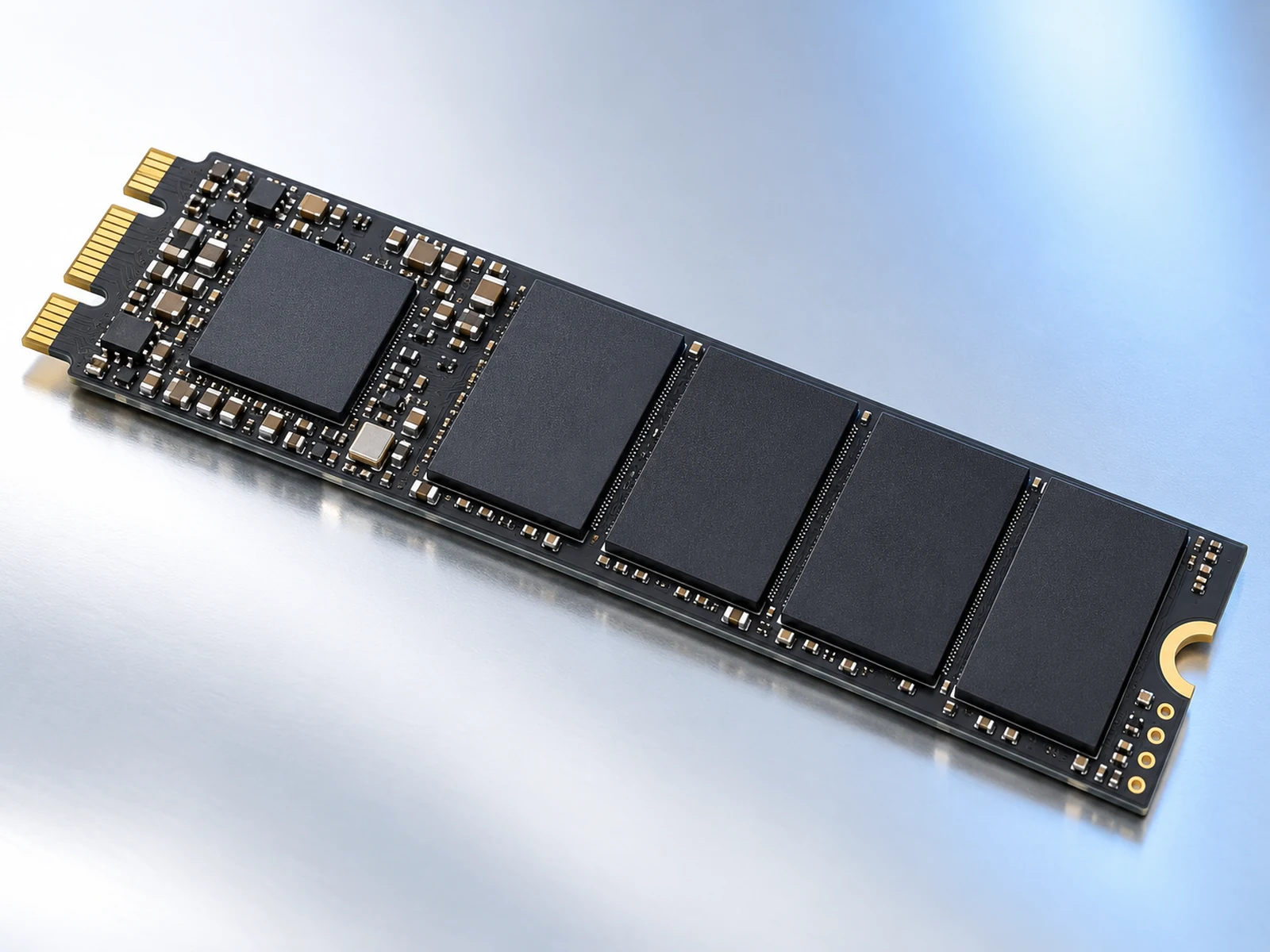
      • SATA protocol: This M.2 board uses SATA, not PCIe NVMe. The physical M.2 shape alone does not identify the protocol.
      • M.2 host socket compatibility: The host M.2 socket and controller must explicitly support SATA; notch shape alone is insufficient.

      Choose the SATA drive around the duty.

      Commercial and enterprise-class drives use the same SATA interface but differ in the workload for which each model is designed. Capacity, endurance, sustained behaviour, power-loss handling and host compatibility matter more than a generic class label.

      ClassForm factorCapacity envelopeInterfaceNANDDRAMPower-loss protection
      Commercial SATA2.5-inch480 GB–4 TB proposed selectionSATA 6 Gb/s3D TLC or model-specific classModel-dependentDo not assume hardware PLP
      Enterprise SATA2.5-inch480 GB–15.36 TB across multiple proposed familiesSATA 6 Gb/s3D TLC/eTLC by approved modelModel-dependentHW PLP on selected verified models
      Commercial SATAM.2 2280 (SATA)480 GB–4 TB proposed; supplier 4TB SKU pendingSATA 6 Gb/s; SATA-capable M.2 host required3D TLC or approved alternativeModel-dependent; DRAM-less existsModel-specific; no blanket guarantee
      Enterprise SATAM.2 2280 (SATA)Selected capacities; verified SSSTC examples to 960 GBSATA 6 Gb/s; SATA-capable M.2 host requiredeTLC/TLC by sourceModel-dependentModel and specification-dependent

      Commercial SATA · 2.5-inch

      Class
      Commercial SATA
      Form factor
      2.5-inch
      Capacity envelope
      480 GB–4 TB proposed selection
      Interface
      SATA 6 Gb/s
      NAND
      3D TLC or model-specific class
      DRAM
      Model-dependent
      Power-loss protection
      Do not assume hardware PLP

      Enterprise SATA · 2.5-inch

      Class
      Enterprise SATA
      Form factor
      2.5-inch
      Capacity envelope
      480 GB–15.36 TB across multiple proposed families
      Interface
      SATA 6 Gb/s
      NAND
      3D TLC/eTLC by approved model
      DRAM
      Model-dependent
      Power-loss protection
      HW PLP on selected verified models

      Commercial SATA · M.2 2280 (SATA)

      Class
      Commercial SATA
      Form factor
      M.2 2280 (SATA)
      Capacity envelope
      480 GB–4 TB proposed; supplier 4TB SKU pending
      Interface
      SATA 6 Gb/s; SATA-capable M.2 host required
      NAND
      3D TLC or approved alternative
      DRAM
      Model-dependent; DRAM-less exists
      Power-loss protection
      Model-specific; no blanket guarantee

      Enterprise SATA · M.2 2280 (SATA)

      Class
      Enterprise SATA
      Form factor
      M.2 2280 (SATA)
      Capacity envelope
      Selected capacities; verified SSSTC examples to 960 GB
      Interface
      SATA 6 Gb/s; SATA-capable M.2 host required
      NAND
      eTLC/TLC by source
      DRAM
      Model-dependent
      Power-loss protection
      Model and specification-dependent

      SATA capacity depends on the drive family. Documented 2.5-inch examples reach 15.36 TB. The 4 TB M.2 2280 SATA option remains a proposed range target pending supplier model selection.

      SATA 6 Gb/s defines the connection class, not guaranteed application speed. Actual sequential throughput, random IOPS and sustained write behaviour depend on the exact drive, capacity and workload. M.2 SATA does not operate at PCIe NVMe speeds.

      What matters inside the drive.

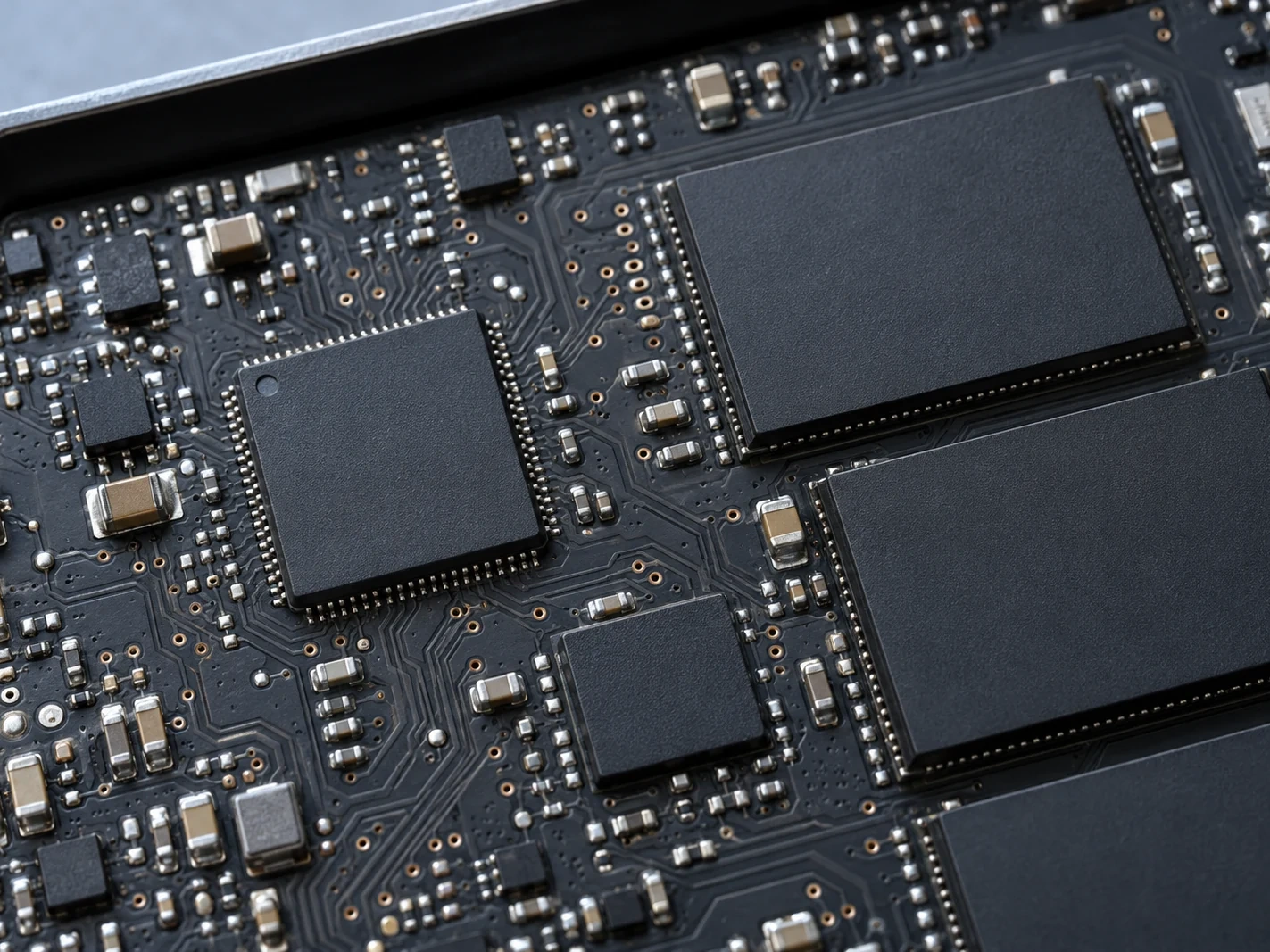
      Close view of SATA SSD flash packages and controller on an intact circuit board

      NAND, controller and cache.

      Persistent NAND flash holds the data; the controller manages its movement, mapping and protection. Some designs use dedicated DRAM while others are DRAM-less. Neither NAND label nor a DRAM badge alone establishes suitability for sustained AI-related storage work.

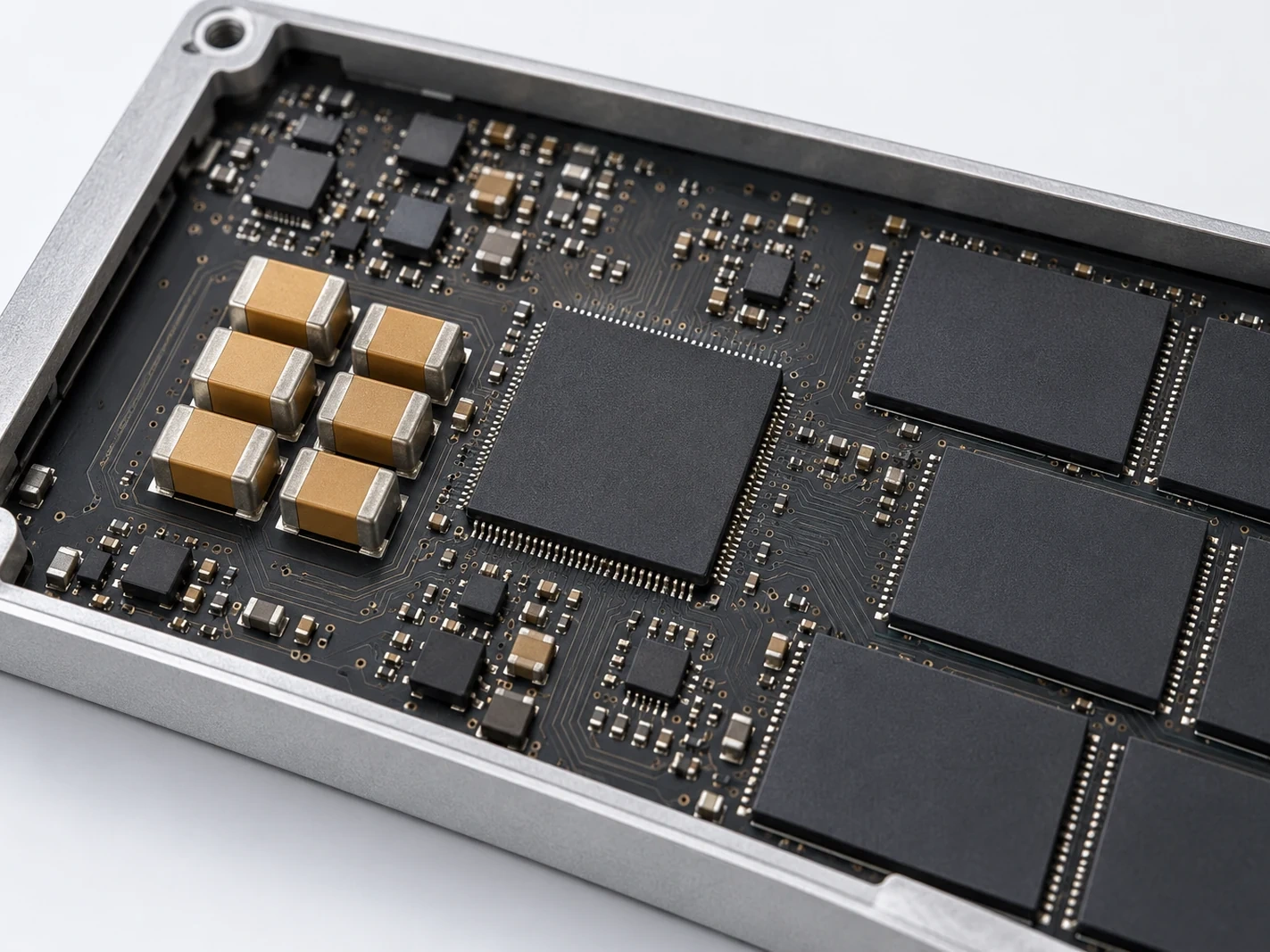
      Close view of a selected enterprise SATA SSD protection circuit

      Power protection and write endurance.

      Selected enterprise drives use hardware capacitors and firmware to address interruption during active writes. Firmware recovery is not identical to hardware hold-up power, and neither replaces backups. Assess endurance, write intensity and sustained behaviour against the drive’s actual duty.

      SATA SSD in a workstation service bay with restrained status interface

      Security, health and ongoing operation.

      Encryption and TCG Opal support, S.M.A.R.T. reporting and data-path protection vary by product. The relevant question is whether the chosen drive and host platform support the required functions, not whether a generic enterprise label appears on the enclosure.

      Host compatibility and installation.

      A 2.5-inch SATA SSD needs the correct data and power connection, enclosure fit and compatible host or bay. An M.2 2280 SATA board requires a host socket that supports SATA rather than PCIe-only NVMe. Hot-plug, cooling and service access depend on the complete platform.

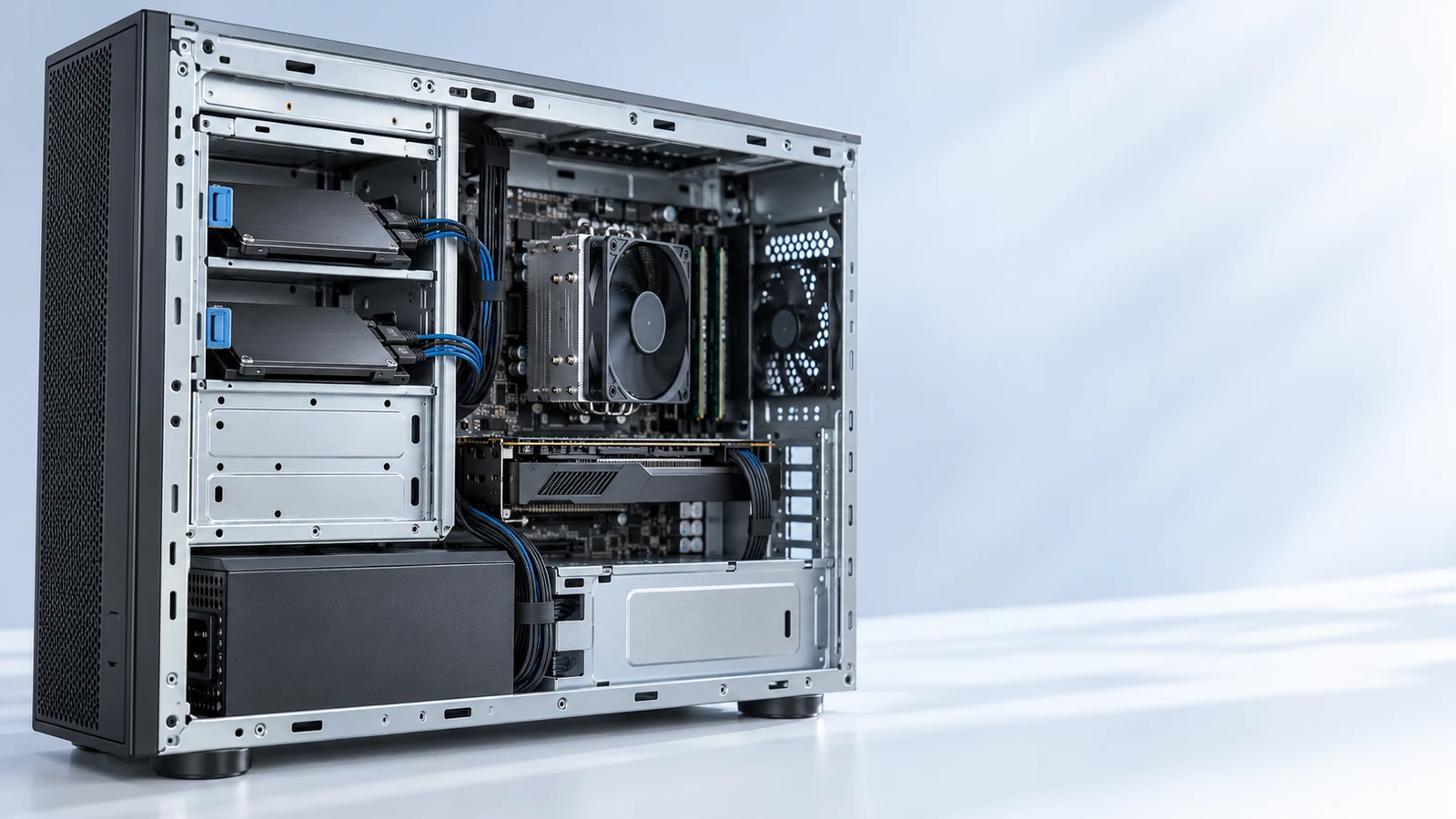
      Open workstation showing two SATA SSDs in front drive bays, their connections and surrounding hardware.

      Where SATA fits

      • System and application storage
      • Model libraries
      • Retained datasets and production content
      • Read-oriented capacity tiers

      A SATA SSD can improve access over compatible hard-disk arrangements, but it does not accelerate GPU arithmetic or replace high-bandwidth NVMe staging when storage throughput is the constraint.

      Storage that fits the rest of the machine.

      An SSD must suit the data, the storage connection and the complete host system. Drive capacity, installed interfaces, bay population, endurance and servicing needs determine how SATA fits beside NVMe, host memory and GPU acceleration.

      Cloud 9 sources SATA SSDs for suitable component upgrades and complete workstation or AI server configurations. The selection follows what the machine needs to store and how the application uses that data.